

The World Economic Forum’s Strategic Intelligence Report on Artificial Intelligence makes one thing clear: AI is not coming, it is here.
Across industries, AI systems are accelerating data analysis, pattern detection, forecasting, and strategic synthesis. Organizations are embedding AI into workflows. Governments are debating governance frameworks. Leaders are asking how to integrate it responsibly.
But alongside acceleration, the Strategic Intelligence report highlights something equally important: as AI absorbs routine analytical tasks, uniquely human capabilities become more valuable: complex problem framing, ethical judgment, critical thinking, collaboration, adaptability, leadership.
In other words, the very capacities at the heart of facilitation.
At a recent conference workshop on AI and Facilitation, we explored what this shift means for our field. The tone in the room was not panic. It was thoughtful tension. Facilitators are not afraid of learning new tools, we are wrestling with deeper questions.
If AI can generate workshop designs, strategic plans, and action steps in seconds, what becomes of our craft? If it can synthesize large data sets and cluster themes instantly, where do we add value? If knowledge is universally accessible, what value would the facilitator add?
These are not technical questions. They are identity questions.
Participants quickly acknowledged the practical benefits. AI can support preparation, design, documentation, and reporting. It can analyze survey results, summarize stakeholder interviews, and generate structured options. Used well, this frees time, and time is precious in our work. That time can be reinvested in deeper listening, reflection, relationship building, and real-time responsiveness to a group.
But the conversations also surfaced risk. If everyone draws from similar models, do we lose distinctive approaches? If strategy outputs become standardized, does creativity flatten? If we outsource too much of our cognitive labor, do we weaken our own discernment?
The concern is not that AI is too powerful. The concern is that humans may disengage from taking responsibility for thinking and owning their decisions.
Another insight from the workshop aligned directly with the World Economic Forum’s research: organizations need space during this transition. They need structured conversations about how AI will be used, where it should not be used, how bias will be addressed, and who carries accountability when systems fail.
Governance is not a technical function. It is a leadership function. And leadership conversations require facilitation.
To bring clarity, we mapped a simple comparison between three roles: Consultant, Facilitator, and AI.
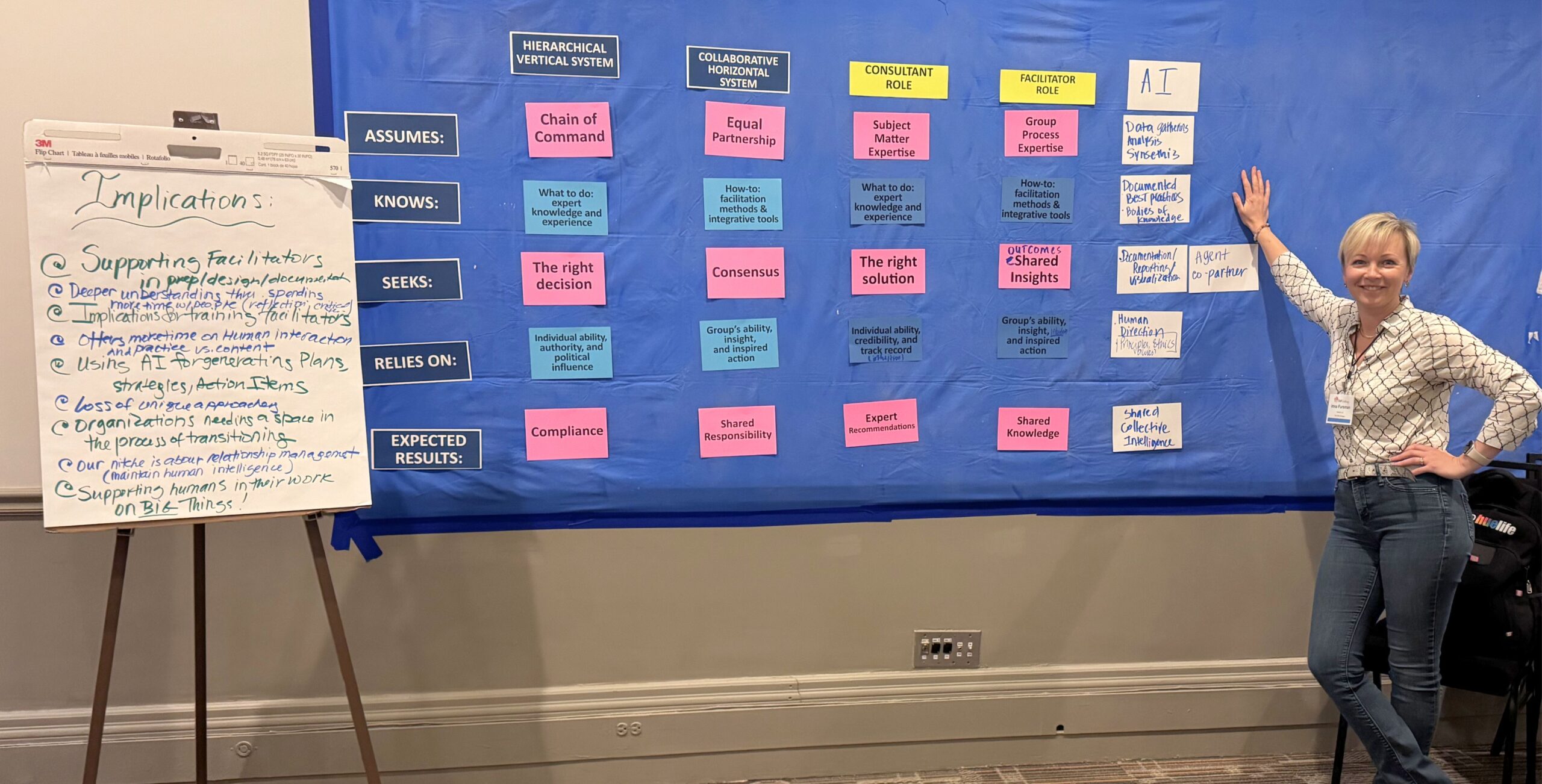
A consultant traditionally operates from subject-matter expertise. The consultant knows what to do. They seek the right solution. They rely on credibility and experience. The expected result is an expert recommendation.
A facilitator operates from process expertise. The facilitator knows how to guide a group toward shared insight. They seek collective intelligence and ownership. They rely on the group’s ability to generate meaning together. The expected result is shared understanding and inspired action.
AI operates from pattern recognition and predictive logic. It processes massive datasets, synthesizes documented knowledge, and generates structured outputs based on probability. It relies on existing data. The expected result is analysis, options, and optimized scenarios.

That is the human role, thus we need to continue to protect and develop human intelligence.
AI mirrors certain aspects of cognition: logic, prediction, synthesis. But does it create meaning? Does it experience emotion? Can it sense tension in a room? Does it know intuitively what is being said behind the words? Does it know when to challenge a group’s unexamined assumptions?
Facilitation’s primary purpose is to question, reflect and create new concepts, new ideas, new future! It exists because meaning does not emerge from data alone, it emerges from the conversation and deeper reflections where humans are engaged in problem solving, taking risks, and dare to think together.
In our workshop, one phrase resonated deeply: “Our niche is maintaining human intelligence.”
In a world flooded with generated content, what becomes scarce is not information. It is trust. It is ethical clarity. It is shared purpose. It is accountability.
AI can produce a plan.
It cannot carry responsibility for the impact of that plan.
AI can surface trends.
It cannot decide what is right.
Facilitators are not competing with AI. We are stewarding how intelligence, artificial and human, is used. We design the conversations that clarify assumptions, surface values, and establish ethical guardrails. We create the conditions where data becomes insight and insight becomes wise action.
The World Economic Forum report emphasizes that governance and oversight will define successful AI integration. That responsibility will not rest solely with technologists. It will rest with leaders, and leaders will need structured spaces to think together.
This is where facilitation becomes indispensable.
The future of our field is not about competing with AI, nor surrendering to its unmatched to humans’ capacity to gather, analyze, and synthesize data. It is about conscious partnership, where human and artificial intelligence is fueled by facilitation.
AI strengthens access to data and gathers available information.
Facilitation creates space for processing and meaning generation.
Human intelligence carries responsibility for action.
In our session, we closed with the challenge for facilitators: we must partner with AI in support of humans working on “big things.” AI will continue to learn and change the way we do things; but we, as facilitators, must help humans learn and evolve with a sense of purpose and responsibility. And that may be the most important role facilitators will play in this next chapter.