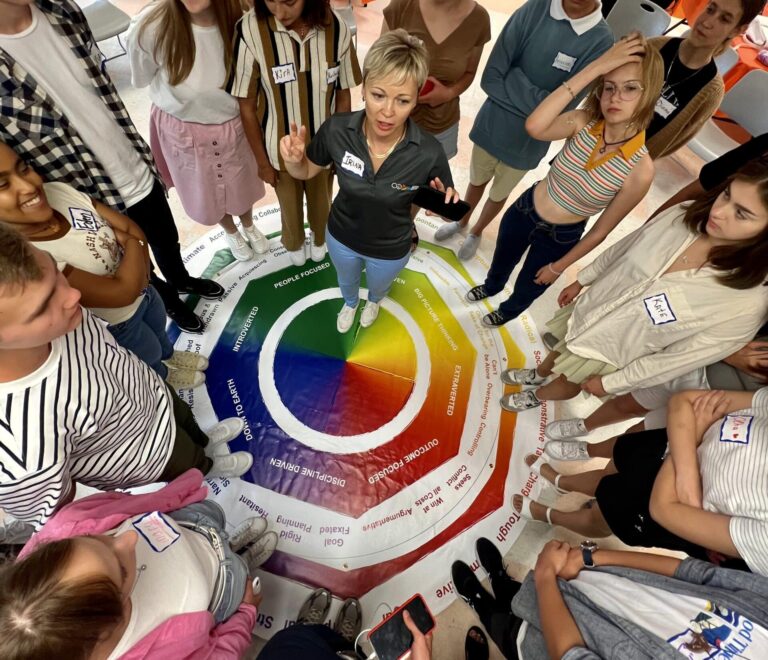
Lumina Spark is a personality assessment tool that reveals the full spectrum of an individual’s personality through a framework of four color qualities — Red for those who are driven and results-focused, Blue for those who are analytical and precise, Green for those who are empathetic and relationship-oriented, and Yellow for those who are expressive and energizing. Most of us carry a blend of all four, but we each have a natural lean. And that lean quietly shapes how we read everyone around us.
We don’t experience people as they are — we experience them through the filter of our own personality wiring. Our brains interpret tone, pace, and behavior based on what we would mean if we acted that way. That’s why it’s so easy to assign intentions that were never there and why we so often end up with unintended offense in group settings. A fast‑moving Red may look like they’re bulldozing when they’re simply being efficient. A quiet Blue may seem disengaged when they’re actually processing deeply. A harmony‑seeking Green may appear avoidant when they’re trying to protect the group. And an enthusiastic Yellow may look chaotic when they’re simply generating energy.
When we separate intention from interpretation, facilitation becomes far more effective and far less personal. Instead of reacting to what we think someone meant, we must create space to understand what they were actually trying to contribute and guardrails to hinder our biases. This shift is especially important in group settings, where diverse personalities collide and where misinterpretations can quickly derail momentum, trust, or psychological safety.
The truth is, if we judge another personality type using our own preferences as the standard, we will almost always misread their behavior. What feels “too much” or “not enough” is often just “different.” And different isn’t a threat — it’s data. It’s information about how someone processes the world, what they value, and how they naturally show up in a group.
The most effective facilitators replace assumptions with curiosity. Instead of asking, “Why are they doing that?” they ask, “What need or value might this behavior be expressing?” That single shift transforms friction into understanding — and understanding into better facilitation. When we honor the diversity of personality in the room, we create spaces where people feel seen, respected, and able to contribute at their best.